 Skip to content
You're Not Imagining This
Something changed in your child. Overnight, or close enough to overnight that it felt that way. The child who was fine last week is now consumed by fear, rage, rituals, or behaviors that don’t make sense to anyone, including them. You’ve been told it’s anxiety. Or a phase. Or parenting. But your gut says something is wrong.
Trust that instinct.
PANS (Pediatric Acute-onset Neuropsychiatric Syndrome) and PANDAS (Pediatric Autoimmune Neuropsychiatric Disorder Associated with Streptococcal Infections) are real, recognized conditions in which a child’s immune system mistakenly attacks the brain, specifically a region called the basal ganglia. The result is a sudden, dramatic onset of neuropsychiatric symptoms that can look like OCD, anxiety, tics, rage, regression, or all of the above at once.
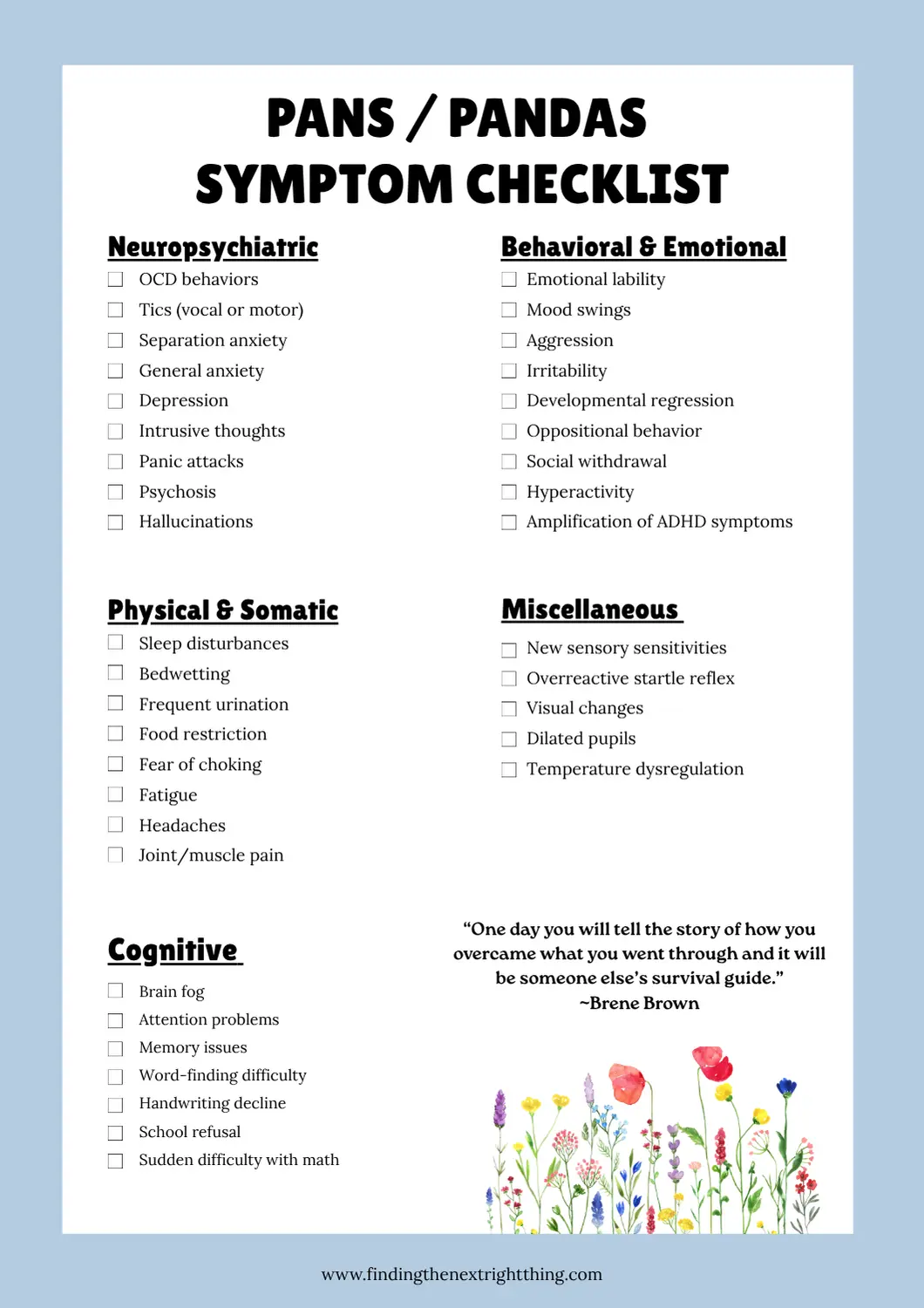
The checklist below covers the full range of symptoms associated with PANS and PANDAS. Not every child will have every symptom. But if a cluster of these appeared abruptly, and especially if they seemed to come on after an illness, that pattern matters.
For a full explanation of what PANS and PANDAS are, what triggers them, and what’s actually happening in the brain, see What is PANS/PANDAS?
PANS and PANDAS Symptoms Checklist
How these symptoms manifest in children with PANS and PANDAS can vary greatly, but they generally fall into a few categories.
1. Obsessive-Compulsive Behaviors (OCD)
OCD in PANS and PANDAS is often the most visible symptom, but it doesn’t always look like what people expect. Yes, it can be handwashing and germ fear. But it also shows up in ways that most people don’t recognize as OCD at all.
Our oldest son’s hands were raw and red from over-washing. He wore moisturizing gloves to bed for months. Two of my other boys had what we call “repeated reassurances,” asking the same questions twenty-five times in an hour. “Mommy, how old are you? Mommy, what’s your favorite color?” It looked like pestering. It was OCD.
Common OCD presentations in PANS/PANDAS include:
- Excessive handwashing, showering, or cleaning rituals
- Compulsive confessing (“I think I lied” or “I had a bad thought”)
- Needing constant reassurance (“Are you sure I’m okay?” or “Am I going to wake up tomorrow?”)
- Repeating movements, phrases, or words silently or aloud
- Checking and rechecking (doors, school bags, homework)
- Refusing to eat foods that have been “contaminated” by touch or placement — one of mine refused water that had been on the table for an hour because it was “old”
- Insisting others follow specific, rigid rules
- Extreme distress if someone touches their belongings
- Avoiding certain colors, numbers, or people — one of my sons had a strong preference for left over right and odd numbers over even
- Needing to align objects “just right” before moving on
- Compulsive touching, tapping, or blinking
- Difficulty completing tasks due to perfectionism
- Intrusive, distressing thoughts they can’t explain or control
- Indecision driven by obsessive thinking
- Fear of accidentally hurting someone or doing something wrong
- Fear of choking or vomiting on certain foods or textures
- Refusing to use certain utensils, bathrooms, or items
If the OCD appeared abruptly and out of character, that sudden onset is a key diagnostic signal.
When our psychiatrist showed me the CY-BOCS (Children’s Yale-Brown Obsessive Compulsive Scale), I was surprised by how many behaviors on that list I recognized in my kids that I never would have labeled as OCD. It covers the full range of ways OCD can show up: contamination fears, aggressive thoughts, magical thinking, symmetry, hoarding, and more. If you want to see how wide that net really is, it’s worth a look before your child’s next appointment.
2. Severe Anxiety and Separation Anxiety
Anxiety in PANS/PANDAS isn’t typical childhood worry. It’s intense, often irrational, and frequently appears with no prior history of anxiety. Separation anxiety is a hallmark of PANS and PANDAS: children who were previously independent may refuse to leave a parent’s side, sleep alone, or go to school.
Two of my kids slept with me for close to a year. One became suddenly and completely terrified of crabs after catching COVID at the beach. The fear was so strong he physically climbed up my body when he saw one. Another locked himself in the closet during thunderstorms.
Other common presentations:
- Sudden, extreme fear of things that weren’t previously frightening
- Panic attacks or meltdowns that escalate faster than expected
- Refusal to go to school, leave the house, or be in another room without a parent
- New phobias appearing overnight
- Hypervigilance or a constant state of alert
- Clinginess in a child who was previously confident and independent
- Fear of death, illness, or something bad happening to themselves or their parents
3. Tics or Motor Abnormalities
Tics can be motor (involving movement) or vocal (involving sounds or words), and they often appear in clusters. In PANS and PANDAS, tics tend to come on suddenly, may shift or change over time, and often worsen during flares.
One of my sons started making nonstop monkey noises in class after a strep infection. He would grunt during flares. It was involuntary. He couldn’t stop it.
Common examples:
- Eye blinking or rolling
- Facial grimacing or nose scrunching
- Neck jerks or shoulder shrugging
- Repetitive throat clearing or sniffing
- Grunting, humming, or other involuntary sounds
- Repeating words or phrases out of context (echolalia)
- Sudden jerking movements of the arms or legs
- Complex, multi-step motor sequences they repeat without control
Tics can overlap with OCD compulsions. In PANS/PANDAS, the distinction between a tic and a compulsion is sometimes blurry, and both can be present at the same time.
4. Sleep Disturbances
Sleep disruption is nearly universal in PANS and PANDAS. The neuroinflammation and dysregulated nervous system that drive daytime symptoms don’t switch off at night.
For us, this looked like nightly wake-ups between 2:30 and 3:30 a.m., where one of my boys would be up for the day. I started treating those wake-ups like newborn feeds: quiet snack, dark room, snuggle, then back to sleep. It didn’t always work, but it bought us more sleep than nothing.
Common sleep issues:
- Night terrors or nightmares that are vivid and distressing
- Difficulty falling asleep due to anxiety or racing thoughts
- Frequent waking throughout the night
- Early morning waking with inability to return to sleep
- Insomnia
- Daytime fatigue with nighttime hyperactivity
- Talking or crying out during sleep
- Refusing to sleep alone or in their own room

5. Emotional Lability, Irritability, Oppositional Defiance and Mood Changes
Emotional dysregulation is one of the most disruptive and least understood aspects of PANS and PANDAS. These children aren’t having tantrums. Their nervous system is stuck in a constant fight-or-flight state. A useful clinical sign of this is dilated pupils, even in normal lighting: a visible indicator that the sympathetic nervous system is on overdrive.
We’ve had holes in walls. Flipped furniture. We learned to remove anything that could become a projectile and kept siblings separated when needed for safety. It was that severe.
What this can look like:
- Explosive rage episodes that are disproportionate to the trigger
- Rapid, unpredictable mood swings
- Prolonged emotional recovery after a meltdown
- Sudden crying with no identifiable cause
- Oppositional or defiant behavior that is out of character
- Verbal or physical aggression toward family members
- Threats or statements they would never make when well
- Dilated pupils, especially during or before a flare
- A glazed or “not quite there” look in the eyes
The key phrase here is “out of character.” A child who was easygoing, flexible, and kind is now volatile. That shift matters.
6. Changes in Handwriting and Involuntary Movements
Changes in handwriting, called dysgraphia, are one of the more striking and concrete signs of the neurological impact of PANS and PANDAS. Writing involves complex coordination between the brain, nervous system, and fine motor muscles. The basal ganglia, which is the primary target of the immune attack, plays a central role in that coordination.
Handwriting may become:
- Dramatically larger than before
- Much smaller, cramped, or harder to read
- Inconsistent in size and spacing within the same word or sentence
- Significantly regressed compared to previous ability
The before-and-after below is from one of my sons. The first sample is from a spelling worksheet days before a strep infection. The second is from the day the infection hit.
Days Before Strep Infection.

Day of Strep Infection.

Beyond handwriting, you may also observe:
- Clumsiness or coordination problems in a previously coordinated child
- Awkward pencil grip or difficulty holding utensils
- Tremors or subtle shaking
- Unusual posturing or positioning of hands and arms while writing
7. Decline in School Performance
A sudden drop in academic ability is a direct consequence of neuroinflammation affecting the basal ganglia and the prefrontal cortex, both of which are essential for learning, memory, and focus.
My son was advanced in math at age seven. After a flare, he forgot the number between four and six.
What this can look like at school:
- Sudden difficulty with math, reading, or writing
- Forgetting material that was previously mastered
- Inability to follow multi-step instructions
- Poor working memory: losing track mid-task or mid-sentence
- Difficulty starting or completing assignments
- Difficulty sitting still, focusing, or filtering out distractions
- Appearing “zoned out” or confused in class
- Reluctance or refusal to go to school
8. Behavioral or Developmental Regression
Regression in PANS and PANDAS can range from subtle to dramatic. It can affect speech, behavior, motor skills, social functioning, or toileting. The key is that these are previously mastered skills. The child isn’t delayed; they’ve gone backward.
Common examples:
- Reverting to baby talk or losing vocabulary
- Needing help with dressing, bathing, or other self-care tasks they managed independently
- Loss of interest in friendships, play, or hobbies they previously loved
- Temporary loss of toileting skills, including daytime accidents in a fully trained child
- Emotional or social functioning that looks younger than their age
- Difficulty with tasks that were easy before, such as tying shoes or using utensils
Regression is distressing for both the child and the family. The child usually knows something is wrong but can’t explain or control it.
9. Somatic Symptoms
Somatic symptoms are physical symptoms that arise from neurological inflammation. They’re often dismissed as unrelated or “just anxiety,” but in PANS and PANDAS they are part of the same immune-mediated process.
Bedwetting was always a reliable early warning sign for us. Before any behavioral symptoms became visible, it would show up first.
Common somatic symptoms:
- Bedwetting or daytime accidents in a previously trained child
- Urinary frequency (needing to go urgently, many times throughout the day)
- Joint pain, especially in the knees and ankles
- Headaches
- Stomach pain or nausea
- Sensory sensitivities: to light, sound, touch, or smell
- Food restriction or sudden aversion to previously accepted foods
- Changes in appetite (dramatic increase or decrease)
- Fatigue disproportionate to activity level
Physical symptoms alongside behavioral changes are a significant pattern. When a child develops bedwetting, joint pain, and sudden OCD at the same time, that’s not coincidence.

The Clinical Diagnostic Criteria
The formal diagnostic criteria for PANS and PANDAS were developed by researchers at the NIMH and are outlined clearly in a handout from ASPIRE (Autoimmune & Autoinflammatory Encephalitis Alliance), a leading clinical and advocacy organization in this space.
For PANS, the criteria require:
- Abrupt, acute onset of OCD and/or severe food restriction
- Concurrent presence of symptoms from at least 2 of 7 categories: anxiety, emotional lability, irritability or aggression, behavioral regression, school performance decline, sensory or motor abnormalities, and somatic signs
- Symptoms not better explained by another neurologic or medical disorder
For PANDAS, the criteria add strep-specific requirements: presence of OCD and/or tics, age of onset between 3 years and puberty, acute and episodic (relapsing-remitting) course, association with Group A Streptococcal infection, and neurological abnormalities.
You can download the full ASPIRE diagnostic criteria handout here.
A note on "acute" onset
The word acute in the diagnostic criteria implies a sudden, dramatic, overnight change. And for many children, especially those triggered by strep, that’s exactly what it looks like.
But a growing number of clinicians and researchers are finding that not every child fits that picture. Some children show a slower, more gradual build of symptoms over weeks or months rather than days. Practitioners working in this space are seeing this pattern more frequently in children whose PANS appears to be driven by:
- Mold and mycotoxin exposure. Chronic low-level neuroinflammation can produce a creeping symptom onset rather than a sharp one
- Gestational Lyme disease. Children born to mothers with untreated or undertreated Lyme may have had an underlying inflammatory burden from birth, making the “before” picture harder to define
- Multiple overlapping triggers. When the immune system is chronically activated by several stressors at once, symptoms may accumulate gradually rather than spike overnight
This matters because a child who developed anxiety, OCD, and tics over six months, rather than six days, may still have PANS. The mechanism is the same. The timeline is just slower. And that slower timeline has historically made these kids easier to miss and harder to diagnose.
If your child’s onset was gradual rather than sudden, that doesn’t rule PANS out. Bring the full symptom picture to a provider familiar with the condition and push for a thorough workup.
A Note to the Parent Reading This
When something is wrong with our children, we will move mountains. We will fight every battle, push through every door, and refuse to quit. That is not in question. But even superheroes have to rest. You cannot save anyone — including your child — if you are running on empty.
If you have read this far, you are probably exhausted in a way that is hard to explain to people who haven’t lived it.
PANS and PANDAS don’t just happen to a child. They happen to a family. You are managing meltdowns, medical appointments, school meetings, sibling stress, and your own grief, often all at once, often without much support, and often while being told by someone in a white coat that nothing is wrong.
That is an enormous weight to carry. And it matters that you are carrying it, because your child needs you to still be standing.
You are a superhero. Not metaphorically — functionally. You are doing the work of a researcher, a case manager, an advocate, a therapist, and a parent, simultaneously, for a child whose condition most of the medical world still doesn’t fully understand. That is extraordinary. Own it.
But even superheroes have an origin story that includes learning their limits.
You cannot pour from an empty cup. That isn’t a platitude — it’s a clinical reality. Caregiver burnout in families of children with chronic illness is well-documented. When a parent is depleted, sleep-deprived, and running on adrenaline, their capacity to advocate, to stay regulated during their child’s dysregulation, and to make clear-headed treatment decisions is compromised. Taking care of yourself is not a luxury. It is part of your child’s treatment plan.
A few things worth saying plainly:
Your mental health matters. Anxiety and depression are common in parents of children with PANS and PANDAS. If you are struggling, that is a reasonable response to an unreasonable situation, not a weakness. Talking to a therapist, especially one familiar with medical complexity or chronic illness, can help.
You are allowed to grieve. The child who existed before onset is still your child. But the loss of who they were before, the ease, the joy, the version of family life you expected, is real. Grief and hope can exist at the same time.
Sleep is not optional. We know. Night disturbances are part of the disorder. But protecting your own sleep wherever possible, splitting nights with a partner, accepting help from family, adjusting your own schedule, is worth prioritizing. Everything is harder with no sleep.
Find your people. Isolation is one of the most common experiences in PANS/PANDAS families. Most people in your life will not understand what you are going through. Finding other parents who do — through online communities, local support groups, or organizations like the PANDAS Network — can be the difference between feeling alone and feeling held.
Lower the bar on what “good enough” looks like right now. Not every meal will be nutritious. Not every sibling will get equal attention. Not every appointment will go well. You are in a season of triage. Done is better than perfect, and present is better than polished.
You are doing something incredibly hard. The fact that you are here, reading this, learning, pushing for answers, that is love in action. Make sure some of that care turns back toward you.
If This Sounds Familiar
PANS and PANDAS are still under-recognized. Many families see 3 to 7 providers before getting a diagnosis. A pediatrician who isn’t well versed in these conditions may dismiss sudden behavioral changes as anxiety, ADHD, or a behavioral problem. That doesn’t mean they’re right.
Keep a symptom log. Note when symptoms started, whether an illness preceded them, and how the picture has changed over time. That documentation will matter when you find the right provider.
Don’t stop asking questions.
What's Actually Happening — and Why It Matters
The symptoms above are the result of an immune system that has turned against the brain. When the body fights an infection, it can produce antibodies that mistakenly attack the basal ganglia. That neuroinflammation disrupts neurotransmitters like dopamine, serotonin, GABA, and glutamate, and the result is the cluster of symptoms above.
Understanding the mechanism helps you push for the right kind of treatment: one that addresses the immune dysregulation driving the symptoms, not just the symptoms themselves.
For a full explanation of the biology, triggers, and what keeps PANS/PANDAS burning, read What is PANS/PANDAS?.
📚 Recommended Reading and Listening
Books
Demystifying PANS/PANDAS by Dr. Nancy O’Hara – a must-read for families pursuing integrative or functional approaches.
A Light in the Dark for PANDAS & PANS by Dr. Jill Crista– Dr. Crista has a great way of explaining complex medical issues in terms parents can understand. This book is about healing PANS/PANDAS holistically with herbal medicine.
Break the Mold by Dr. Jill Crista – another great book by Dr. Crista, but this time specifically on healing from mold illness with herbal medicine.
Toxic: Heal Your Body from Mold Toxicity, Lyme Disease, Multiple Chemical Sensitivities, and Chronic Environmental Illness by Dr. Neil Nathan. A great book if you’re dealing with multiple issues, like mold, Lyme, and histamine.
Podcast
Demystifying PANS/PANDAS Podcast by Nancy O’Hara, MD, Could it Be PANS/PANDAS? A Pediatrician Explains the Signs & Solutions
BetterHealthGuy Blogcasts, PANDAS and PANS with Dr. Jill Crista, ND
Frequently Asked Questions
PANS (Pediatric Acute-onset Neuropsychiatric Syndrome) and PANDAS (Pediatric Autoimmune Neuropsychiatric Disorders Associated with Streptococcal Infections) are conditions that cause sudden, dramatic changes in a child’s behavior and neurological function.
These changes are not psychiatric in origin, but rather the result of autoimmune brain inflammation, a type of encephalitis triggered by an inappropriate immune response.
In PANDAS, this immune reaction is specifically associated with a strep infection, while PANS can be triggered by a broader range of factors, such as viruses, Lyme disease, mold exposure, or other environmental triggers. The immune system becomes confused and mistakenly targets healthy brain tissue, particularly the basal ganglia, a region involved in movement, emotion regulation, decision-making, and behavior.
This autoimmune attack can cause sudden-onset symptoms, including OCD, severe anxiety, tics, rage, regression, and sleep disturbances. PANS and PANDAS are considered types of autoimmune encephalitis. Timely treatment is critical to reduce inflammation and restore brain function.
Children with PANS or PANDAS often experience a sudden and dramatic shift in behavior or mental health. Common symptoms of PANS and PANDAS include severe anxiety, obsessive-compulsive behaviors, tics, aggression, emotional outbursts, depression, sensory sensitivities, urinary frequency, and sleep disturbances. These symptoms of PANS/PANDAS often show up quickly, sometimes overnight. And, they can worsen following infections, stress, or environmental exposures. Since the symptoms of PANS/PANDAS can be mistaken for psychiatric disorders but are rooted in neuroinflammation, identifying these flare patterns is key to getting the correct diagnosis and treatment.
Probably more common than most doctors realize. At least 1 in 200 children. Given how often it’s often misdiagnosed as anxiety, OCD, ADHD, or oppositional behavior, it’s likely underreported. In my opinion, many kids, and adults, are slipping through the cracks.
Yes, PANS in adults is real. While the condition is typically diagnosed in children, many adults are now being identified with previously unrecognized cases. Some adults may have carried mild or undiagnosed symptoms since childhood. Others may develop PANS symptoms suddenly after an infection, mold exposure, or other immune trigger. As awareness of PANS increases, it’s important that adults who suspect PANS, find a practitioner open to evaluating through a PANS-informed lens.
Not without treatment. A lot of children improve with age after appropriate treatment. But true remission usually requires healing the gut, supporting detox pathways, addressing latent infections, active detox, correcting nutrient deficiencies and supporting genetic mutations. Even in remission, these kids tend to remain more vulnerable to immune dysregulation. As children grow, the blood-brain barrier becomes less permeable, which can offer some protection, but it’s not a cure on its own. I suspect many adults with severe, treatment-resistant mental health struggles are walking around with undiagnosed/untreated PANS/PANDAS.

No comment yet, add your voice below!